
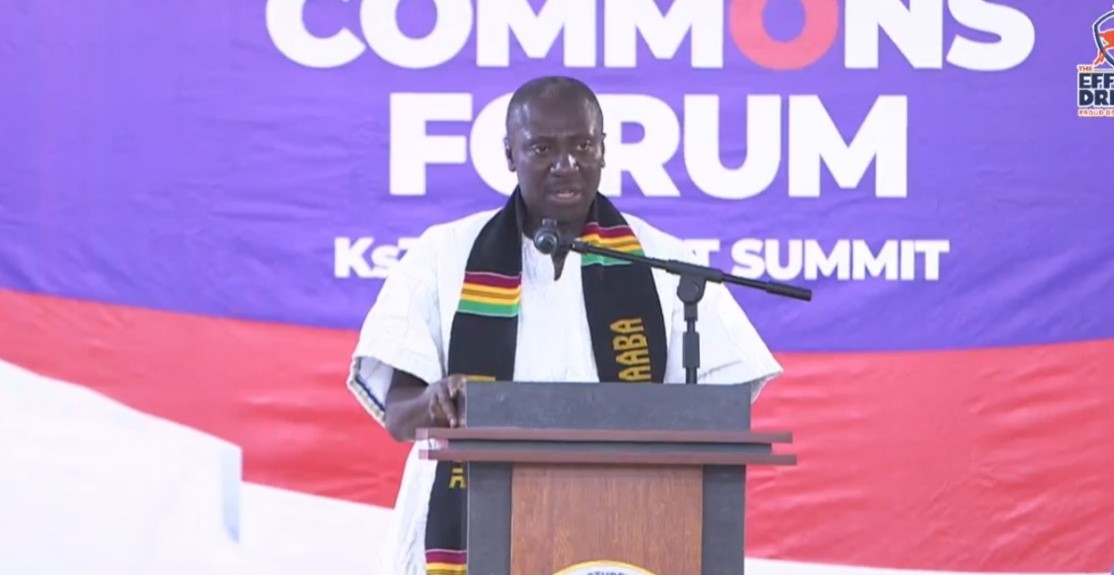
The Minority Leader in Parliament and Member of Parliament for Effutu, Osahen Alexander Kwamena Afenyo-Markin, has said the presidential candidacy of Dr. Mahamudu Bawumia, former Vice-President, is being deliberately framed as an inclusive national project aimed at uniting Ghanaians across ethnic, religious, and political divides.
He explained that the vision being advanced by Dr. Bawumia places national cohesion, equal opportunity, and shared prosperity at the centre of its political philosophy, describing it as a continuation of Ghana’s broader democratic and development tradition. He made the remarks in Kumasi during a lecture at the inauguration of the Young Commons Forum (KNUST & KSTU Chapter) on Saturday, June 20, 2026.
He stated that Dr. Bawumia’s approach to leadership reflects a conscious effort to build a “big tent” political movement that draws on the talents of all citizens, regardless of background. According to him, this framing is intended to ensure that governance is not defined by exclusion or sectional interest, but by collective national purpose and the mobilisation of diverse skills for development.
He further noted that the candidacy emphasises equal participation in national development, arguing that the challenges confronting Ghana require unity of purpose and a leadership style that prioritises inclusion, merit, and opportunity creation for all citizens.
Delivering a lecture titled “Honouring the Foundations, Building the Future: The Danquah–Dombo–Busia Legacy as a Blueprint for Modern Prosperity,” Afenyo-Markin situated the discussion within the broader ideological history of Ghana’s centre-right tradition, tracing it to the founding of the United Gold Coast Convention (UGCC) in 1947.
He recalled the contributions of key founding figures such as Dr. J. B. Danquah, Chief Simon Diedong Dombo, and Professor Kofi Abrefa Busia, describing their ideas as the foundation of a political philosophy rooted in liberty, constitutional governance, private enterprise, and individual empowerment.
According to him, the Danquah–Dombo–Busia tradition has consistently evolved through Ghana’s political history, from the UGCC through the United Party to the formation of the New Patriotic Party (NPP), while maintaining its core belief in rule of law, decentralisation, and a property-owning democracy.
