
Story By: Felix Ernest Odamtten / Muhammad Faisal Mustapha….
Ghana’s campaign against illegal mining has entered another intense phase in the Western Region, with the National Anti-Illegal Mining Operations Secretariat (NAIMOS) stepping up operations along the Asankrangwah–Bawdie–Bogoso corridor, an area spanning parts of Wassa Amenfi Central and Wassa Amenfi East.
On August 7, 2026, a NAIMOS Taskforce conducted a targeted patrol across the corridor, raiding four illegal mining sites and dismantling equipment used to support the operations. The intervention forms part of a sustained enforcement campaign aimed at disrupting illegal mining activities and preventing the further degradation of land and water resources.
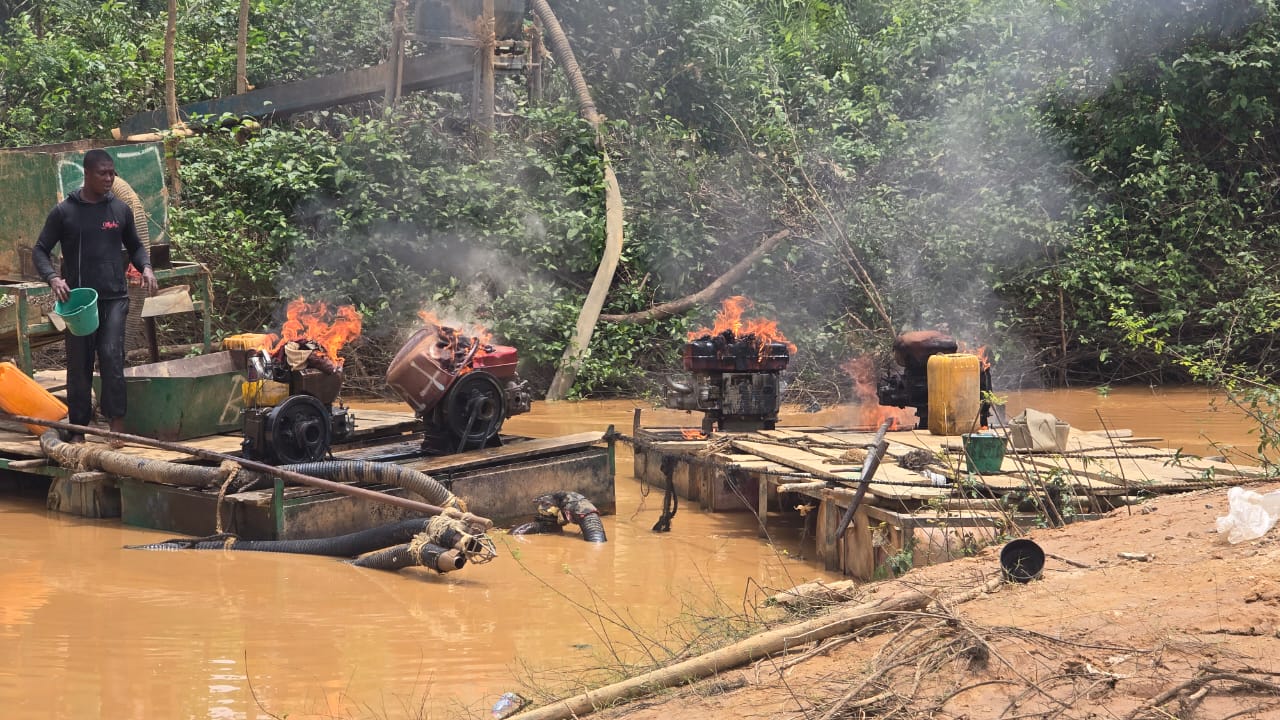
During the operation, personnel destroyed nine water pumps and eight chanfang machines identified as being used in the mining activities. The removal of the equipment was intended to reduce the operational capacity of miners and disrupt the infrastructure that enables illegal mining to continue across the affected communities.
But the latest operation also exposed one of the most difficult realities confronting Ghana’s anti-illegal mining campaign: the ability of operators to return almost immediately after enforcement teams have withdrawn. The Taskforce had conducted an earlier intervention in the same area, destroying mining equipment at some sites, only to find that illegal miners had returned and resumed operations.
The rapid return of miners points to a cycle that has increasingly complicated enforcement efforts. Equipment is destroyed or removed, mining activity temporarily stops, and operators subsequently return with replacement machinery, often exploiting gaps in surveillance and enforcement to restart operations.
“The greatest challenge is no longer simply clearing illegal mining sites, but preventing them from coming back.”
NAIMOS personnel also identified what they described as forms of local support that enable illegal mining to persist. Some operators reportedly continue to benefit from assistance within surrounding communities, while some landowners are alleged to make portions of farmland available for mining activities.
The availability of mining equipment on credit was another factor identified during the operation. According to the findings, operators can obtain replacement equipment without immediately paying the full cost, enabling them to rebuild their operations quickly even after machinery has been destroyed during enforcement actions.
That dynamic creates a difficult enforcement equation. Destroying equipment can disrupt mining temporarily, but if operators retain access to land, financing, machinery and local networks, the underlying business model can survive and quickly regenerate.
“When destroyed equipment can be replaced and cleared sites can be reopened, enforcement alone cannot end the cycle.”
The situation also raises broader questions about the economic incentives surrounding illegal mining. For some landowners and equipment suppliers, mining can offer immediate financial returns, while the environmental costs are distributed across communities through damaged farmland, degraded landscapes and pressure on natural resources.
For NAIMOS, the response will therefore require more than periodic raids. The Secretariat says it will maintain follow-up operations and surveillance along the corridor to prevent illegal mining sites from being re-established and to dismantle supporting infrastructure that allows operators to return.
Sustained surveillance will be particularly important because the corridor covers a wide geographical area and includes communities where mining activities can quickly shift from one location to another. Intelligence led operations can help identify emerging sites before they become established, while continued monitoring can help protect areas already cleared by enforcement teams.
The operation also highlights the importance of community cooperation in Ghana’s fight against illegal mining. Where land is made available for mining or local networks facilitate the return of operators, enforcement agencies face a challenge that cannot be addressed solely through the deployment of security personnel.
“Protecting the land requires communities to become partners in enforcement, not silent observers of its destruction.”»
For the Western Region, the stakes are particularly high. The area has long been associated with gold production, but decades of mining pressure have also placed forests, farmland and water resources under considerable strain, making sustainable management of natural resources increasingly urgent.
The Asankrangwah–Bawdie–Bogoso operation therefore represents another test of Ghana’s determination to break the cycle of illegal mining. The destruction of 17 pieces of mining equipment may provide an immediate disruption, but the lasting measure of success will be whether operators remain unable to return and whether affected communities can be protected from renewed environmental damage.
NAIMOS says it remains committed to sustained, intelligence led operations across affected communities. Along the Asankrangwah–Bawdie–Bogoso corridor, the latest intervention has exposed the resilience of illegal mining networks and reinforced a central lesson of Ghana’s anti galamsey campaign: lasting environmental protection will depend on combining enforcement with surveillance, community responsibility and measures capable of weakening the economic networks that allow illegal mining to return.
