
Story By: Felix Ernest Odamtten / Muhammed Faisal Mustapha….
Minerals Commission has intensified its oversight of the country’s expanding contract mining regime, warning indigenous mining contractors that the drive for greater Ghanaian participation in the industry must not come at the expense of workers’ wages, welfare and conditions of service.
The intervention comes as Ghana deepens its local content agenda, seeking to ensure that a greater share of the economic value generated from the country’s mineral resources remains within the domestic economy while building the capacity of Ghanaian owned businesses to participate meaningfully in the mining value chain.
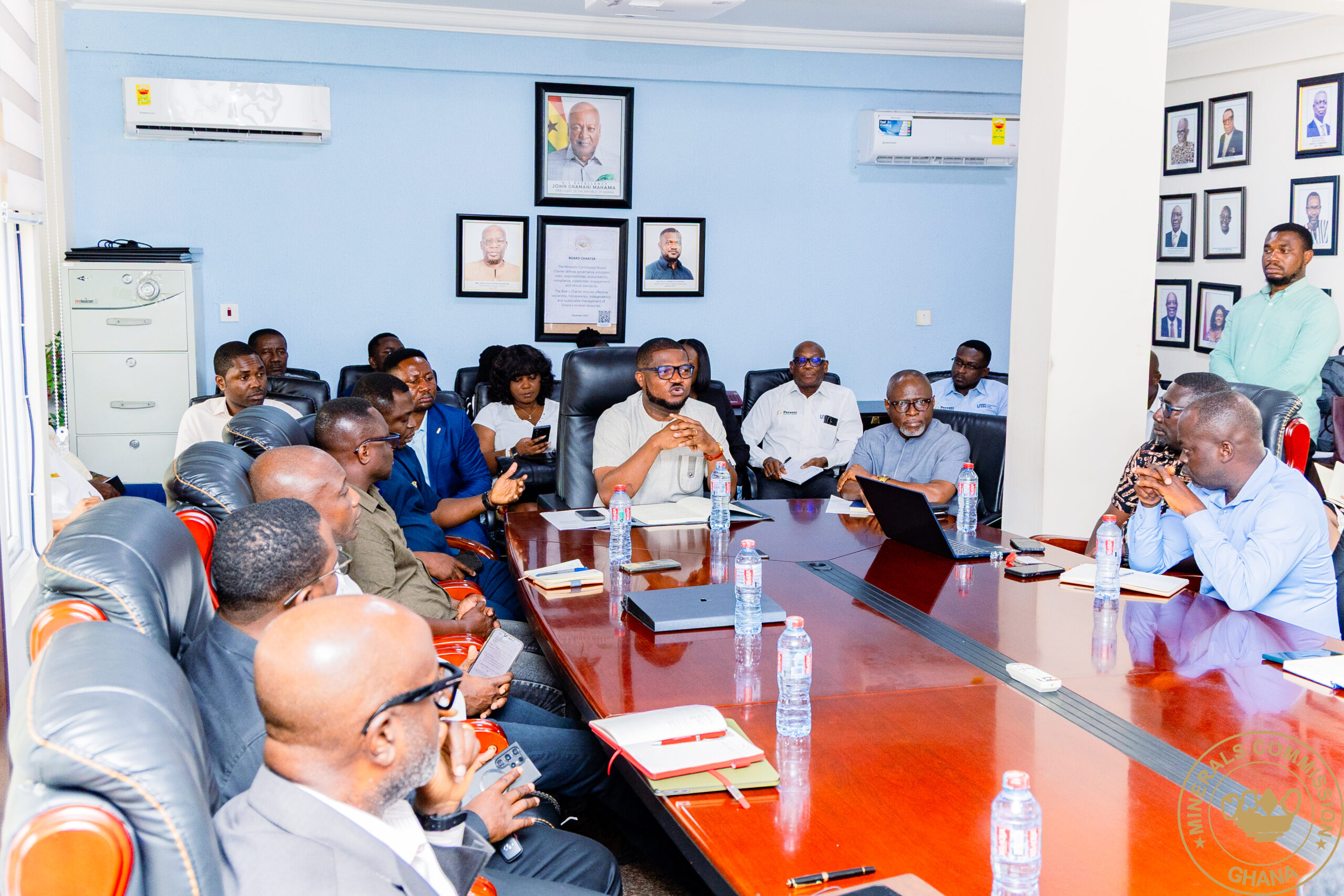
At a meeting with major contract mining companies, the Chief Executive Officer of the Minerals Commission, Mr. Isaac Tandoh, expressed concern about the remuneration and welfare of workers employed by local contractors and stressed that the benefits of Ghanaian participation must extend beyond ownership of mining contracts.
“Local participation must not become merely a change in ownership; it must translate into better opportunities, fair remuneration and improved working conditions for Ghanaian workers.” — Isaac Tandoh
The Commission’s position reflects a growing concern that the success of Ghana’s local content policy should be measured not only by the number of contracts awarded to indigenous companies, but also by the quality of employment, remuneration and professional opportunities created for Ghanaian workers.
Ghana’s policy of transitioning contract mining operations towards 100 per cent Ghanaian ownership has made significant progress, but concerns raised by the Ghana Mineworkers’ Union (GMWU) have brought the issue of workers’ pay increasingly into focus.
At the heart of the concern is the practice of some contractors allegedly underpricing their bids in an effort to secure mining contracts. Industry concerns suggest that when contracts are won at unsustainably low prices, contractors may come under pressure to reduce operational costs, with workers’ remuneration potentially becoming one of the areas affected.
The Minerals Commission has therefore signalled that the financial competitiveness of a contractor should not be considered in isolation from its ability to provide fair and sustainable employment conditions.
Following discussions with the industry, the Commission has asked contract mining companies to develop and submit a framework for addressing workers’ remuneration, including possible industry wide benchmarks for wages and other conditions of service.
Such benchmarks could establish a clearer minimum standard for remuneration across the contract mining sector and help prevent aggressive price competition from undermining the welfare of workers.
Under the proposed approach, labour standards and workers’ remuneration could become important considerations in the tendering and evaluation of future contract mining bids. Prospective contractors may consequently be required to demonstrate not only their technical competence and financial capacity but also their ability to maintain acceptable employment standards.
“A mining contract should not be won at a price that makes decent wages and acceptable working conditions impossible.”
Industry stakeholders are expected to deliberate on the proposed benchmarks before a framework is submitted to the Minerals Commission for consideration and possible approval. If adopted, the mechanism could establish a more consistent approach to remuneration across Ghana’s contract mining industry.
Mr. Tandoh further stressed that, with immediate effect, workers’ remuneration would receive significant attention during the Commission’s review of contract mining arrangements. Contractors that fail to meet acceptable standards could be required to undertake corrective measures or face appropriate regulatory consequences.
The development represents a significant evolution in Ghana’s local content policy, as the focus increasingly moves from transferring business opportunities to indigenous companies towards ensuring that those opportunities generate broader economic and social benefits.
For years, the central argument for increased Ghanaian participation in mining has been that greater domestic ownership would enable more wealth, expertise and business opportunities to remain within the country. The emerging debate now asks a more fundamental question: How much of that benefit reaches the Ghanaian worker?
The Ghana Mineworkers’ Union has raised concerns about alleged differences in wages and employment conditions between workers employed by some local contractors and those performing comparable duties for foreign owned mining companies.
The concerns have added urgency to the debate because the transition towards indigenous contract mining is taking place within a sector where occupational safety, technical competence, productivity and skilled labour are critical to the success of mining operations.
The Minerals Commission’s intervention therefore seeks to balance two important objectives: empowering Ghanaian businesses to become stronger players in the mining industry while ensuring that workers are not disadvantaged by the transition.
“Local ownership must deliver local value and local value must include decent jobs and fair wages.”
For indigenous contractors, the challenge is substantial. Competing for major mining contracts requires access to capital, modern equipment, technical expertise, experienced personnel, strong management systems and internationally acceptable health, safety and environmental standards.
Contractors also face the commercial pressure of competing for contracts in an increasingly competitive market. The Commission’s emerging position suggests that such competition must not be based primarily on the ability to submit the lowest bid, particularly where the consequences could undermine workers’ welfare.
The proposed remuneration framework could therefore become an important instrument for improving the sustainability of Ghana’s contract mining industry, creating greater transparency around labour costs and encouraging contractors to compete on efficiency, innovation, technical capacity and service quality.
For workers, the development could provide greater protection against wage disparities and poor conditions of service, particularly as more mining activities move from multinational operators to Ghanaian owned contractors.
For the Ghanaian economy, meanwhile, the issue extends beyond individual salaries. Fair remuneration strengthens household incomes, supports local businesses, expands the tax base and ensures that the economic benefits of mineral extraction circulate more widely within mining communities and the national economy.
The Minerals Commission’s message is consequently becoming increasingly clear: Ghana’s mining transformation must combine local ownership, regulatory compliance, responsible contracting and worker protection.
As the country seeks to secure greater national benefit from its mineral wealth, the ultimate test of the local content agenda will not simply be how many contracts are held by Ghanaian companies, but whether those companies can build sustainable businesses while creating decent, fairly remunerated and safe employment for Ghanaian workers.
