
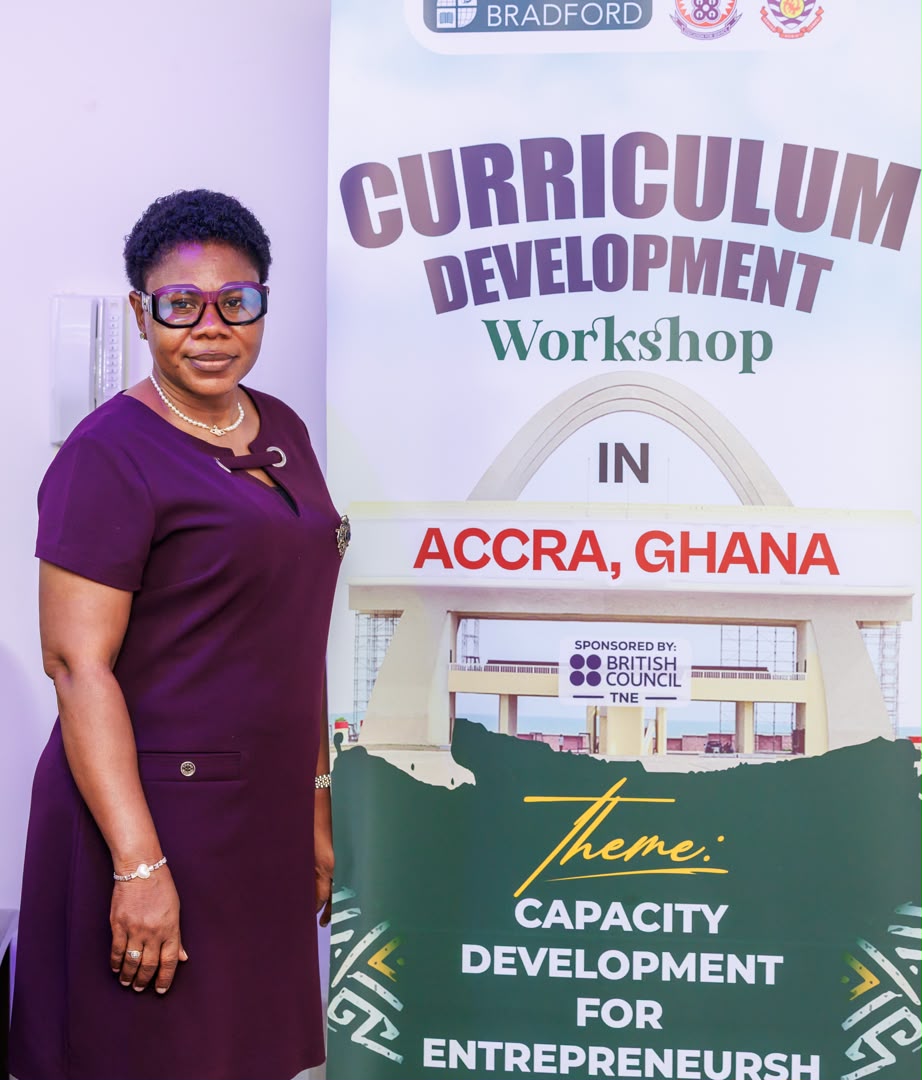
Dr Susan Yaa Aframa Arkah has called for a renewed focus on entrepreneurship, innovation, and agribusiness development as critical drivers of sustainable economic growth across Africa.
Delivering the keynote address on “Entrepreneurship and Agribusiness in the African Context” at the British Council-funded Transnational Education (TNE) Workshop in Accra, Dr Arkah highlighted the immense opportunities available within Africa’s agricultural sector and urged stakeholders to leverage entrepreneurship as a tool for addressing unemployment, poverty, food insecurity, and sustainable development challenges.
Addressing participants from academia, government, industry, and development organisations, Dr Arkah noted that Africa’s rapidly growing youthful population represents one of the continent’s greatest assets. She emphasised that creating opportunities for young people requires a shift from traditional employment models towards entrepreneurial thinking, innovation, and enterprise creation.
“Africa’s future prosperity depends on our ability to transform challenges into opportunities through entrepreneurship, innovation, and value creation,” she stated.
Dr Arkah stressed that agribusiness should no longer be viewed solely as farming but rather as a comprehensive value chain encompassing production, processing, packaging, transportation, marketing, technology, and export development. She argued that significant economic value can be created when African countries move beyond exporting raw commodities and instead focus on value addition and industrial development.
The keynote address further highlighted the growing importance of technology in modern agriculture. Dr Arkah cited examples of young African entrepreneurs developing digital platforms, mobile applications, climate-smart solutions, and innovative financing mechanisms that are transforming agricultural productivity and market access across the continent.
She also underscored the critical role of universities and higher education institutions in fostering entrepreneurial mindsets and preparing graduates to become innovators, job creators, and change-makers rather than solely job seekers.
According to Dr Arkah, sustainable development must remain central to Africa’s entrepreneurial and agribusiness agenda. She called for increased investment in climate-smart agriculture, environmental stewardship, renewable energy, and inclusive business models that empower women, youth, and marginalised communities.
The keynote formed part of a three-day international workshop organised by the University of Bradford in partnership with the University of Cape Coast and the University of Education, Winneba, under a British Council-supported project aimed at developing a Certificate Programme in Entrepreneurship, Agribusiness, and Sustainable Development.
Participants at the workshop are exploring strategies for strengthening entrepreneurship education, enhancing agribusiness ecosystems, promoting university-industry collaboration, and advancing sustainable development across Ghana and Africa.
Concluding her address, Dr Arkah reminded participants that Africa’s greatest resource lies not beneath its soil but within its people.
“When we invest in human capital, entrepreneurial capability, innovation, and sustainable development, we create the foundations for long-term prosperity and transformational change,” she said.
The workshop continues until 13 June 2026 at Mount Everest Hotel, Kwabenya, Accra.
