
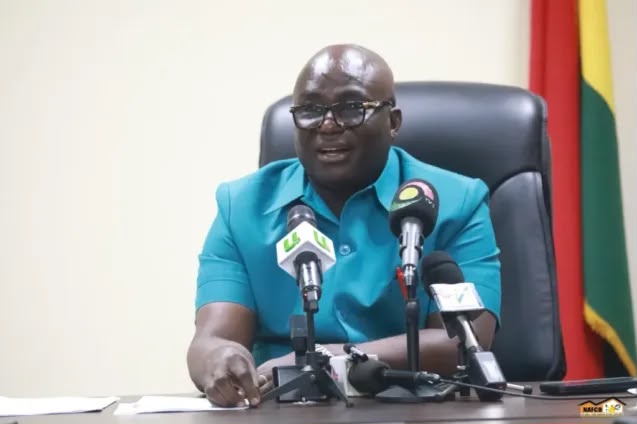
The Minister for Food and Agriculture, Eric Opoku, has disclosed that some beneficiaries of the government’s flagship Nkoko Nkitinkiti programme have consumed the birds they received instead of rearing them for commercial production.
Mr. Opoku made the disclosure when he appeared before Parliament’s Assurances Committee on Thursday, July 9. He explained that one of the key challenges facing the programme has been access to markets for mature birds, particularly in the Eastern Region, where some beneficiaries informed the ministry that they were struggling to sell their poultry.
“Now, the difficulty we have with some of the regions, especially in the Eastern Region, is that some of the farmers who benefited called me and said, ‘Our birds are ready; we are not getting the market,’” he said.
“I said, ‘We can find some market for you.’ So we spoke to some of the processors. Some of them had to move cars from Accra to some of the regions to go and buy the birds,” he stated.
Despite those efforts, Mr Opoku said some beneficiaries opted to slaughter the birds for their own consumption rather than sell them.
“Some also decided to kill and eat all. In fact, they were even sending me videos that ‘we are eating’ everything,” he told the committee.
“But this is not meant for that immediate consumption. We just wanted people to rear them, sell and reinvest so that it becomes business,” he explained.
The minister acknowledged that although the ministry did not support beneficiaries consuming the birds, doing so could still have a positive effect by encouraging the consumption of locally produced poultry.
READ ALSO:24-Hour Economy to Be Powered by Renewable Energy, Industrial Corridors – Goosie Tanoh
“Even though we don’t encourage that, because we wanted them to capitalise on this to earn something for their livelihoods, if that is what they have decided to do, at the national level, in aggregate, it also helps,” he said.
His remarks underscore the government’s broader efforts under the Nkoko Nkitinkiti initiative to increase local poultry production, promote the consumption of locally produced chicken, and reduce Ghana’s reliance on poultry imports.
