
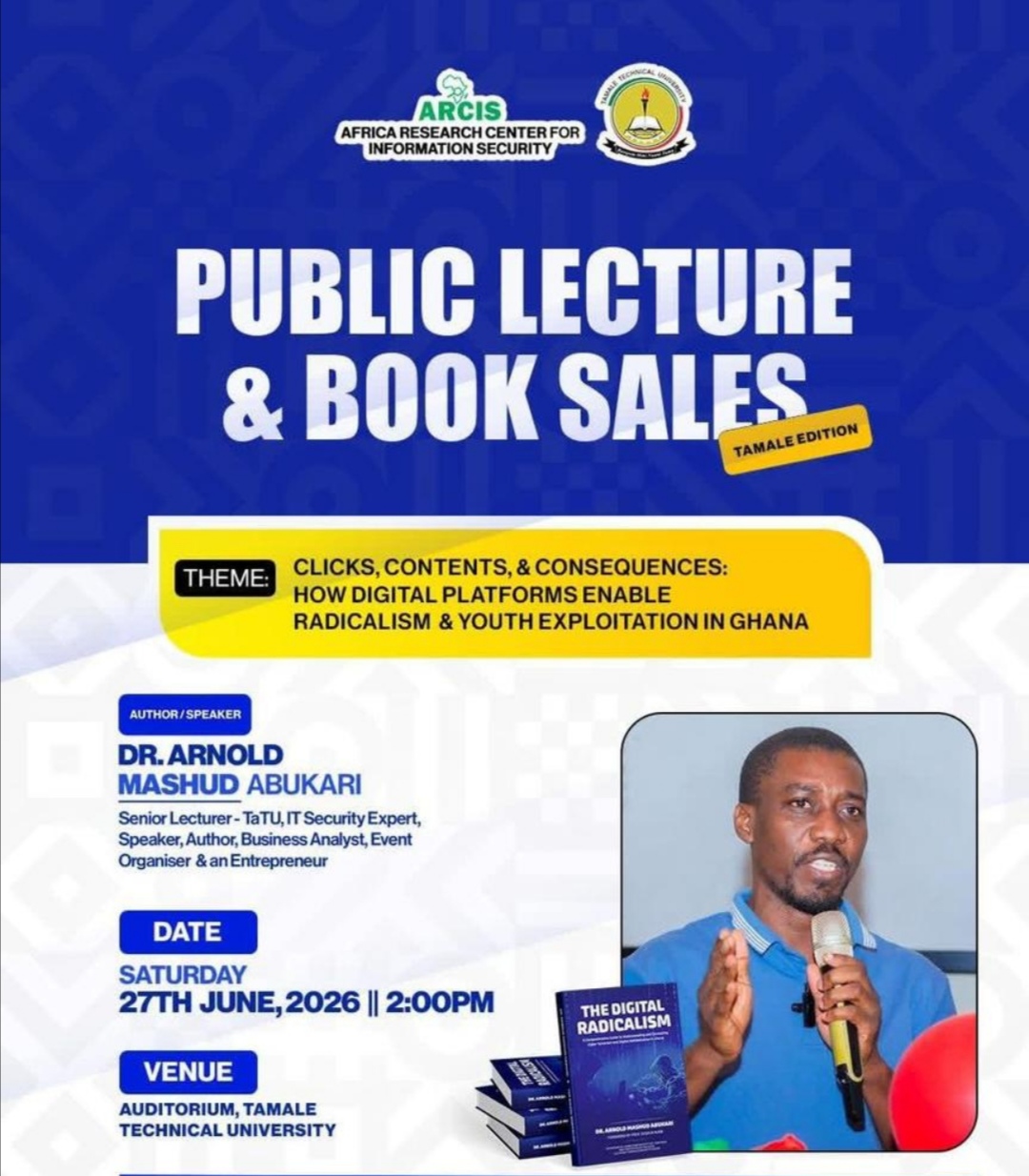
Information security expert and author, Dr. Arnold Mashud Abukari, has called for urgent and coordinated national action to combat the growing threat of online radicalisation, warning that extremist groups are increasingly exploiting digital platforms to manipulate and recruit vulnerable young people in Ghana.
He said the country could no longer afford to treat digital radicalisation as a distant or isolated problem, stressing that the rapid expansion of social media and online communication had created new opportunities for extremist networks to identify, groom and influence susceptible individuals.
Speaking at a post-book launch public lecture at the ICT Auditorium of Tamale Technical University on Saturday, Dr. Abukari urged government institutions, educational authorities, the media, technology companies and civil society organisations to collaborate in strengthening digital awareness and resilience against online extremism.
The lecture, organised by the Africa Research Center for Information Security (ARCIS) in collaboration with Tamale Technical University, was held on the theme: “Clicks, Contents & Consequences: How Digital Platforms Enable Radicalism and Youth Exploitation in Ghana.” It also featured discussions on his newly launched book, The Digital Radicalism.
According to Dr. Abukari, extremist groups increasingly rely on publicly available information shared on social media to identify individuals who may be vulnerable to manipulation.
He explained that online comments, posts and interactions often reveal personal frustrations, ideological leanings, grievances and distrust of institutions, providing valuable intelligence for recruiters seeking potential targets.
“People unknowingly leave behind digital footprints that can expose their emotions, beliefs and vulnerabilities. Extremist groups analyse these patterns and gradually exploit them through misinformation, false promises and carefully crafted narratives,” he said.
Dr. Abukari warned that such activities not only threaten individual victims but also pose wider risks to national security, peace and social cohesion.
He noted that misinformation and disinformation remain among the world’s most pressing short-term risks because they fuel public distrust, deepen political and social divisions, and weaken confidence in democratic institutions.
Beyond radicalisation, the cybersecurity expert highlighted the growing influence of artificial intelligence and cyber threats on global development.
While acknowledging AI’s enormous potential to improve productivity and innovation, he cautioned that technological advancement would significantly reshape labour markets, with nearly 55 per cent of jobs expected to experience disruption in the coming years.
He therefore urged educational institutions to prioritise digital skills development and equip students with competencies that would enable them to compete in an increasingly technology-driven economy.
Dr. Abukari also appealed to young people to become responsible digital citizens by critically evaluating online content, protecting their personal information and avoiding engagement with harmful online narratives.
He encouraged students to cultivate a strong reading culture and share knowledge acquired from digital literacy programmes with their peers, families and communities.
To broaden public understanding of online safety, he recommended that awareness campaigns on digital radicalisation and cybersecurity be translated into local Ghanaian languages and disseminated through radio, television, community outreach programmes and digital platforms.
As part of his commitment to youth empowerment, Dr. Abukari announced a scholarship scheme for five financially challenged students of Tamale Technical University.
Under the initiative, two beneficiaries will be selected from the Computer Science Department, two from the Marketing Department and one from any other department. Three of the scholarships will be awarded to female students and two to male students.
The announcement was warmly received by participants, who described it as a practical demonstration of his commitment to supporting education while promoting responsible digital citizenship.
The public lecture attracted students, lecturers, researchers, information technology professionals and members of the public, and formed part of ongoing efforts to stimulate national conversations on cybersecurity, digital resilience and the protection of young people from emerging online threats.
