
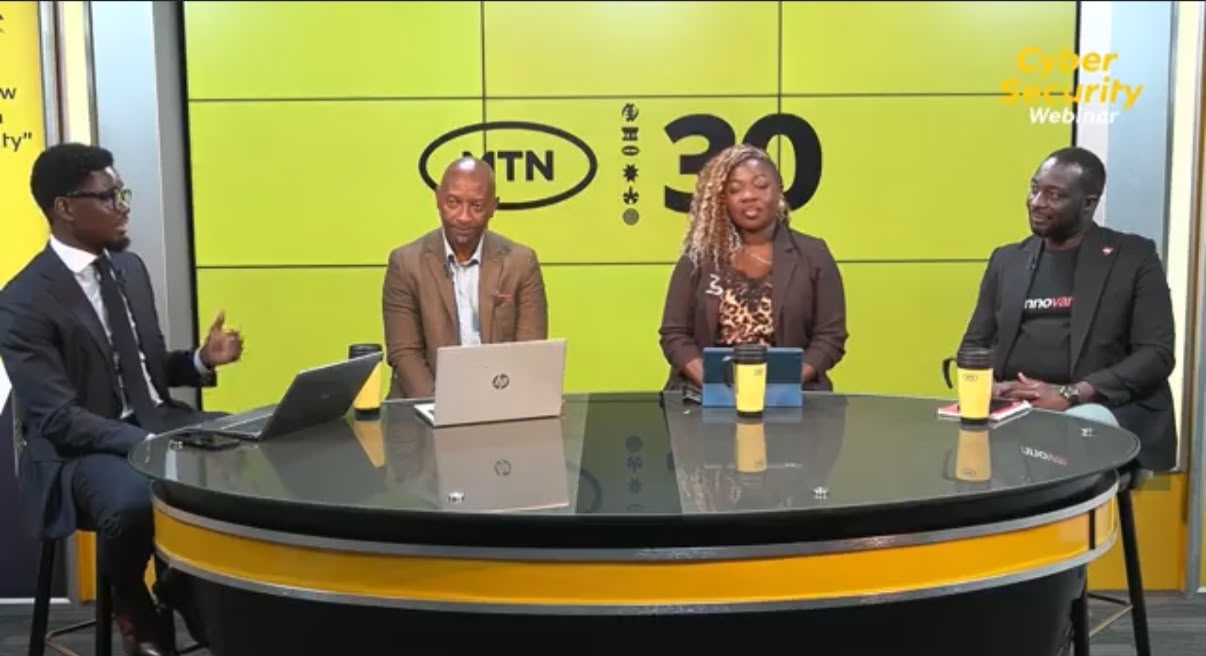
MTN Ghana has held a cybersecurity session to equip small and medium-sized enterprises (SMEs) with practical strategies to protect their operations against digital threats and foster long-term business resilience.
The webinar, organised by MTN Business under its SME Accelerate Programme, highlighted how cyberattacks disrupt daily operations, undermine customer confidence, and threaten the survival of growing enterprises.
Held as part of Cybersecurity Awareness Month under the theme “Secure to Thrive: Building Resilient Businesses in an Era of Digital Disruption,” the session addressed phishing, employee training, incident recovery, third-party risks, responsible artificial intelligence (AI) adoption, and cost-effective defence measures.
The session featured key industry experts, including Jake France, Head of Cybersecurity Technology Standards at the Ghana Cyber Security Authority; Jacqueline Hanson-Kotei, Senior Manager of Enterprise Information Security and Governance at MTN Ghana; and Albert Turkson, Chief Business Officer at Innovare.
Phishing and Social Engineering Pose Major Threats
Ms Jacqueline Hanson-Kotei, Senior Manager of Enterprise Information Security and Governance at MTN Ghana, identified phishing and social engineering as immediate, high-priority threats to SMEs.
She cautioned that cybercriminals frequently deploy fraudulent emails, fake payment notifications, and messages impersonating trusted organisations or familiar contacts to trick business owners and employees into opening malicious attachments or surrendering sensitive corporate information.
“Be careful what you click. Be careful what you scan as QR codes,” Ms Hanson-Kotei urged, advising entrepreneurs to thoroughly scrutinise links, codes, and financial requests before taking any action.
She also encouraged businesses to regularly update their systems and patch technical vulnerabilities, particularly when using older software.
Employee Training Critical to Cybersecurity
Emphasising that, technical safeguards alone are insufficient, Ms Hanson-Kotei stressed that investments in security tools must be reinforced by continuous workforce education, noting that a single careless oversight by an employee can expose an entire network.
“It’s not just an IT issue,” she said, calling for widespread cybersecurity awareness across every tier of an organisation, from frontline and security personnel to chief executives.
Even small businesses with as few as five employees, she noted, must train their staff to recognise suspicious communications and handle sensitive company data securely.
WhatsApp and Mobile Money Fraud Threaten SMEs
Ms Hanson-Kotei drew attention to the acute risks facing micro-enterprises that rely on social channels such as Instagram, WhatsApp, and mobile money services to conduct daily operations.
An account compromise on these sales channels, she explained, immediately interrupts payment processing and customer engagement, while prolonged operational downtime risks driving clients to competitors.
To build internal resilience, she advised SMEs to designate a specific individual to manage cybersecurity matters, enforce multi-factor authentication, perform routine off-site data backups, and conduct security assessments on external third-party vendors supporting their operations.
Ms Hanson-Kotei also, highlighted social engineering as a persistent challenge, citing instances where fraudsters contact customers directly to manipulate them into disclosing PINs or authorising transfers.
She noted that MTN maintains an in-house cybersecurity division to implement infrastructure safeguards, complemented by ongoing staff education to minimise potential vulnerabilities.
Trust but Verify — MTN Cautions Businesses
To illustrate the deceptive nature of digital fraud, Ms Hanson-Kotei recounted receiving an unexpected request for GH¢500 from the compromised WhatsApp account of a makeup artist she knew.
Recognising the unusual request, she verified the situation directly before acting, demonstrating how compromised accounts are leveraged to exploit established trust within personal networks.
“Trust but verify,” she advised, encouraging users to develop the habit of confirming suspicious financial requests through a direct phone call.
Taking a single minute to verify a message’s authenticity, she noted, serves as a low-cost, highly effective defence against financial loss and protects interconnected contacts within a business network.
SMEs Urged to Prepare for Cyberattack Recovery
Ms Hanson-Kotei further urged SMEs to expand their cybersecurity focus beyond prevention to include formal incident response and disaster recovery planning.
“Don’t only think of prevention,” she urged, advising business owners to establish response leads, assign clear operational responsibilities, and arrange access to technical support before an emergency occurs.
She explained that advance preparation enables an organisation to respond systematically during a system disruption, ensuring rapid operational recovery and business continuity.
Cybercriminals Do Not Discriminate — CSA Warns
Jake France, Head of Cybersecurity Technology Standards at the Cyber Security Authority (CSA), warned SMEs against assuming their size shields them from targeted attacks.
“Cybercriminals do not discriminate,” Mr France stated, urging businesses accepting digital payments or managing online inventory to secure their access channels, verify third-party vendor contracts, and confirm the credentials of cybersecurity service providers.
Mr France highlighted physical device security, off-site cloud backups, and clear organisational communication protocols as critical components of continuity planning.
He also urged caution regarding the use of AI tools, warning against sharing sensitive corporate data online and noting that emerging technologies facilitate voice cloning and highly convincing fraudulent communications.
Cybersecurity Investment Essential for Business Survival
Albert Turkson, Chief Business Officer at Innovare, warned of the severe financial and reputational consequences associated with unaddressed cybersecurity vulnerabilities.
“If you’re going to budget for the technology, you should as well budget for how to keep that technology safe,” Mr Turkson advised.
He recommended that resource-constrained SMEs consider managed security services to distribute costs while maintaining internal oversight through regular website vulnerability assessments and penetration testing.
Drawing lessons from global economic disruptions, Mr Turkson emphasised that business continuity planning is vital for enterprises of all sizes.
On AI governance, he recommended standard frameworks such as ISO 42001 and advised businesses to remove identifying details from corporate data before using AI platforms.
Source: Isaac Kofi Dzokpo
