
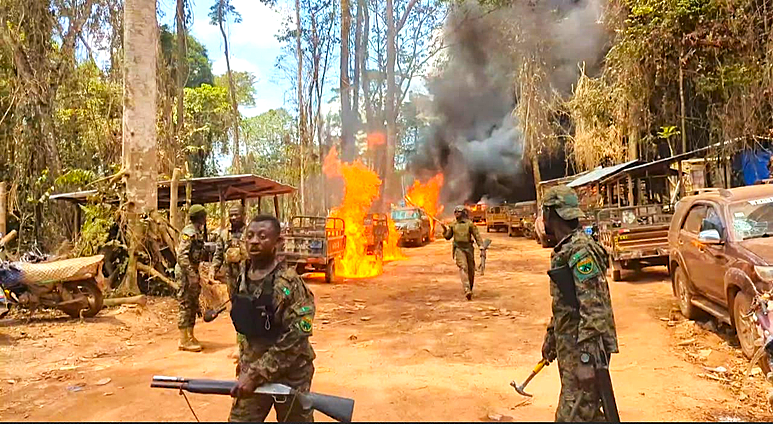
The Forestry Commission is considering setting up permanent armed security camps at illegal mining hotspots in the Subri River Forest Reserve in the Western Region to stop miners from returning to areas cleared during enforcement operations.
The proposed move follows reports that more than 1,000 armed illegal miners are operating in the reserve, raising concerns about the safety of forest officers and the continued destruction of forestland.
Western Regional Manager of the Forestry Commission, Nana Poku Bosompim, said the plan would involve deploying armed rapid-response teams, introducing modern surveillance equipment and strengthening cooperation with security agencies.
According to him, although previous operations have led to arrests, prosecutions and the destruction of mining equipment, illegal miners often return to the forest once security personnel leave.
To address the problem, the Commission intends to station teams of about 13 armed officers at identified hotspots after illegal miners have been removed.
The officers will be provided with motorbikes, vehicles, CCTV cameras and Starlink internet connectivity to help them monitor activities, communicate effectively and respond quickly to security threats.
Mr Bosompim said the officers had also received specialised training to operate in difficult forest conditions.
“We should not allow the Subri River Forest Reserve to fall into that category of a red zone. It would be a failure of epic proportions on the part of all of us if we allow the situation in Subri River to degenerate,” he warned.
Forest Destruction Reduced, But Threat Remains
The Forestry Commission says its enforcement efforts have helped reduce the area of degraded forestland in the reserve from about 680 hectares to 282 hectares, representing a reduction of nearly 60 per cent.
Despite the progress, Mr Bosompim acknowledged that the fight against illegal mining was far from over, as miners continue to return to previously cleared locations.
The Subri River Forest Reserve covers more than 58,000 hectares and remains one of the Western Region’s important forest ecosystems.
He explained that protecting such a large area requires constant monitoring, adequate personnel and sustained security operations.
The Western Region alone has 19 forest reserves covering approximately 209,333 hectares, making enforcement a major challenge for the Commission.
“Something has been done, but I can also say we are nowhere near winning the fight. There is still more work to be done. That tells us we need to sustain the fight,” he admitted.
Regional Minister Calls for Joint Action
Meanwhile, Western Regional Minister Joseph Nelson has called for closer cooperation among state institutions responsible for fighting illegal mining.
He wants the Forestry Commission, military, Navy, Air Force, National Anti-Illegal Mining Operations Secretariat (NAIMOS) and other security agencies to coordinate their activities and share intelligence.
According to him, stronger collaboration would help prevent armed illegal mining groups from returning to forest areas after security operations.
Mr Nelson expressed concern that some institutions were carrying out separate operations despite working towards the same goal.
“The Forestry Commission is doing something on its own. On the same challenge, we have NAIMOS. How is the collaboration like? And interestingly, the two institutions are under the same ministry,” he questioned.
He urged the agencies to combine their resources, expertise and operational plans to make the fight against illegal mining more effective.
“Working in silos won’t help anybody,” he stressed.
The proposed security camps are expected to strengthen surveillance and maintain a continuous security presence in the reserve, helping the Forestry Commission protect areas already recovered from illegal miners and prevent further environmental destruction.
